
English

English
Significant Improvement in Overall Post-Warming Survival,
with a 13.75-Percentage-Point Increase in the NOD Live Birth Rate
【Customer Profile】
The customer is a leading company in the laboratory-animal industry with stringent requirements for consistency in embryo vitrification, warming, and post-transfer breeding outcomes. Three mouse strains—C57, BALB/c, and NOD—were included in this comparative evaluation.
【Challenge】
Manual vitrification and warming are highly dependent on operator experience, which can lead to variation across batches and mouse strains. For immunologically susceptible, valuable, or difficult-to-breed strains such as NOD mice, this variation can directly affect strain preservation, colony expansion, and delivery outcomes.
【Biorocks Solution】
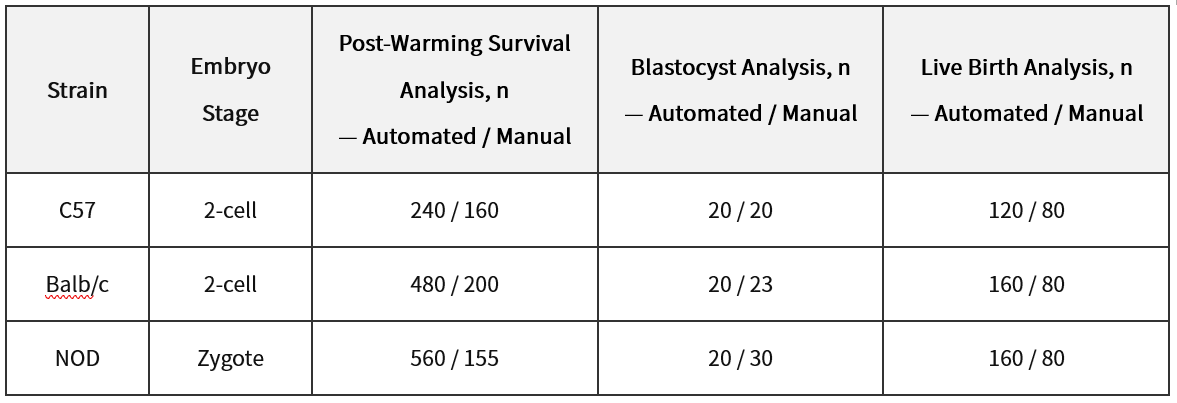
The customer introduced the Biorocks Automated Vitrification & Warming System to standardize critical processing steps. The automated workflow was compared with the company's manual procedure using the same evaluation criteria. Post-warming survival rate, blastocyst development rate, and live birth rate were assessed, with Z-tests performed separately by strain.
【Experimental Design】
【Key Outcome Comparison】
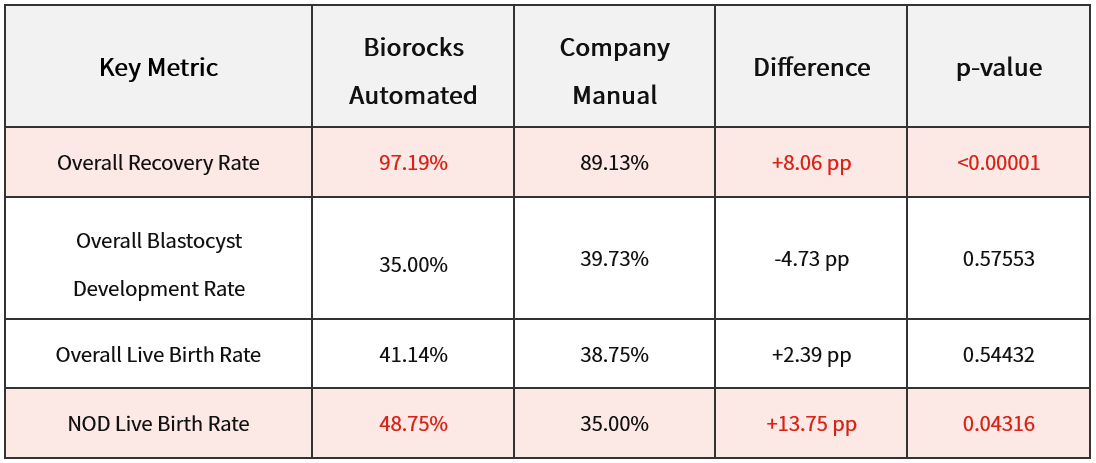
The Biorocks automated workflow achieved an overall post-warming survival rate of 97.19%, an improvement of 8.06 percentage points over the manual group. The difference was statistically significant (p<0.00001). No statistically significant differences were observed in the overall blastocyst development rate or overall live birth rate, indicating that the automated process improved post-warming consistency without evidence of reduced subsequent developmental or reproductive potential.
For the NOD strain, the live birth rate increased from 35.00% to 48.75%, an improvement of 13.75 percentage points. This difference was statistically significant (p=0.04316).
【Practical Value】
1. Improved Post-Warming Consistency: The significantly higher overall post-warming survival rate can help reduce sample losses associated with batch-to-batch variation.
2. Preserved Developmental Potential: No statistically significant evidence of inferior blastocyst development or overall live birth outcomes was observed compared with the manual group.
3. Potential Benefit for Challenging Strains: The significant improvement in the NOD live birth rate provides relevant evidence for preservation and colony expansion of immunologically susceptible, valuable, or difficult-to-breed strains.
4. Standardized Operation: Automated execution of critical steps provides a more reproducible workflow for processing multiple strains and batches.